Nearsightedness
Myopia
Distant objects look blurry while close work stays clear. The laser flattens the central cornea slightly so distant light focuses on the retina instead of in front of it.
LASIK reshapes the cornea so light focuses properly on the retina. It can correct nearsightedness, farsightedness and astigmatism — and for most people, sharply reduce how much they depend on glasses and contacts.

Current offer
New semester, new perspective. Book your LASIK consultation before the end of the year.
Offer expires December 31, 2026.
Schedule AppointmentCannot be combined with any other offer or insurance. You must mention this offer to qualify.
Poor eyesight generally comes down to two things: an eyeball that is too long or too short, and a cornea that is too steep, too flat, or an irregular shape. Research has shown that changing the size and shape of the eyeball itself is impractical and ineffective, so laser vision correction works by reshaping the cornea instead.
Our team offers LASIK and other vision correction options to patients across the Joliet area. Call (815) 729-3777 to book a LASIK consultation or any other eye care appointment.
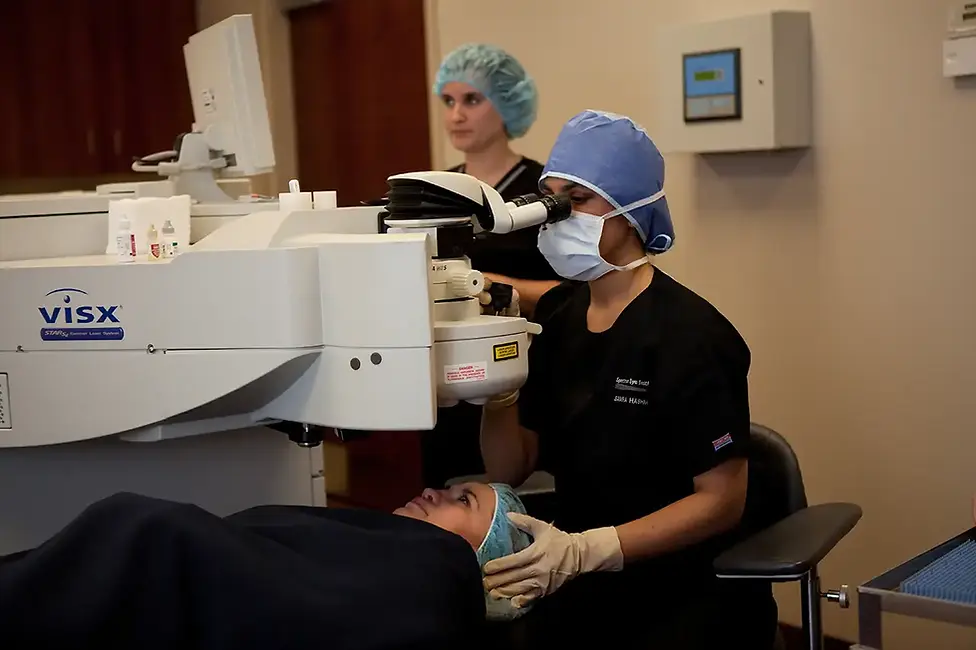
Our experienced team starts with a comprehensive consultation to understand your vision and talk through the best options for you. Our surgeons use a femtosecond laser system. Patients with nearsightedness, farsightedness and astigmatism can all benefit from LASIK.
Your consultation will confirm whether LASIK is the right procedure for your eyes.
Myopia
Distant objects look blurry while close work stays clear. The laser flattens the central cornea slightly so distant light focuses on the retina instead of in front of it.
Hyperopia
Close work is harder than distance vision. The laser steepens the central cornea so near light focuses on the retina rather than behind it.
Irregular corneal shape
An unevenly curved cornea blurs vision at every distance. The laser smooths that curvature, and astigmatism is often treated at the same time as nearsightedness or farsightedness.
Reading glasses
LASIK does not eliminate the need for reading glasses. Presbyopia — the age-related loss of near focus — continues regardless, and some patients still need an enhancement, glasses or contacts afterward.
About results: outcomes vary from person to person, and the figures sometimes quoted for LASIK come from published studies rather than from our own patients. Your surgeon will give you a realistic picture of what LASIK can do for your eyes at your consultation.
A consultation is the only way to know. Book online or call and we’ll talk it through.
LASIK is done as an outpatient procedure. Numbing eye drops go in right before surgery, and a mild sedative is available if you are anxious. The eyelid is cleansed and held open with a small instrument, and the other eye is covered.
A thin, hinged flap is created in the surface of the cornea and folded back to expose the tissue underneath. The laser is then applied for roughly 30 to 60 seconds, depending on how much correction is needed, and the laser’s computer calculates the exact number of pulses. You will hear a snapping sound and may notice a faint odor. The flap is then laid back in place without stitches, and antibiotic and anti-inflammatory drops are put in.
Most patients feel no discomfort during the procedure itself. There can be mild discomfort for the first few days afterward, sometimes helped by pain relief and artificial tears, but most people are comfortable throughout recovery.
Many patients notice a marked improvement almost immediately, but your best vision may take several days or weeks — occasionally months — to settle. Because of the blurriness and any sedative, you cannot drive yourself home, and surgery will not go ahead unless a driver is present or other arrangements are made.
You will be seen the day after surgery, then at about one week and one month, with extra visits if needed. The main thing to protect in the first one to two weeks is the flap: avoid rubbing your eyes, be careful of fingernails, and wear the protective shields we give you while you sleep for the first few nights.
Drops matter. Following the medication schedule closely lowers the risk of infection, keeps you comfortable and gives you the best visual result. Most patients only need them for a few weeks.
Vision improves without glasses for the great majority of patients, but some still need an enhancement, glasses or contact lenses afterward. LASIK does not treat presbyopia, so reading glasses are still likely as you get older.